A RESEARCH STORY · 3 MIN READ
More forest land, less standing timber: two views of Czech forests
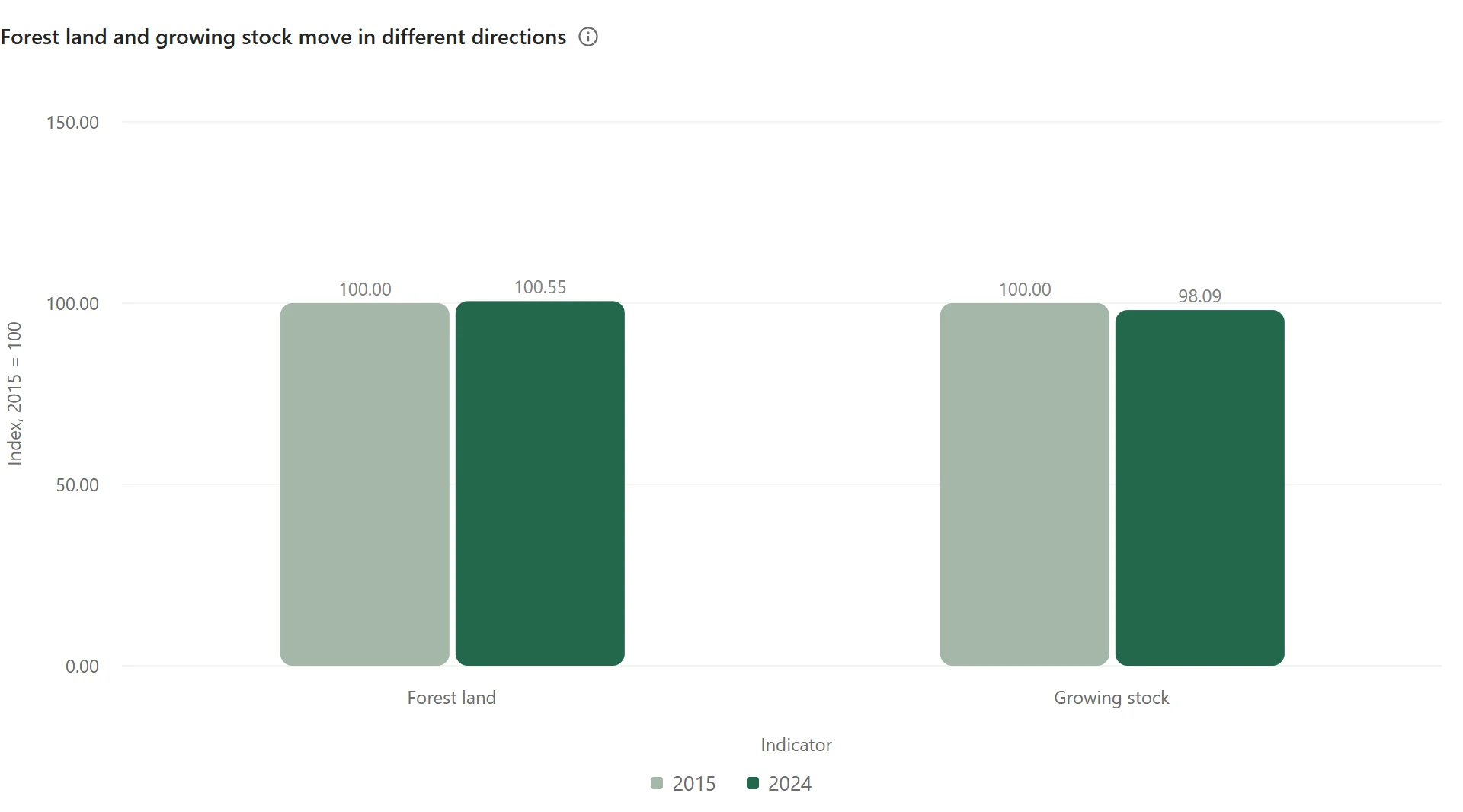
Between 2015 and 2024, recorded forest land expanded by 14,746 hectares while standing timber volume fell by 13.2 million cubic metres. Two figures from the Czech forestry reports offer different perspectives on a changing forest.
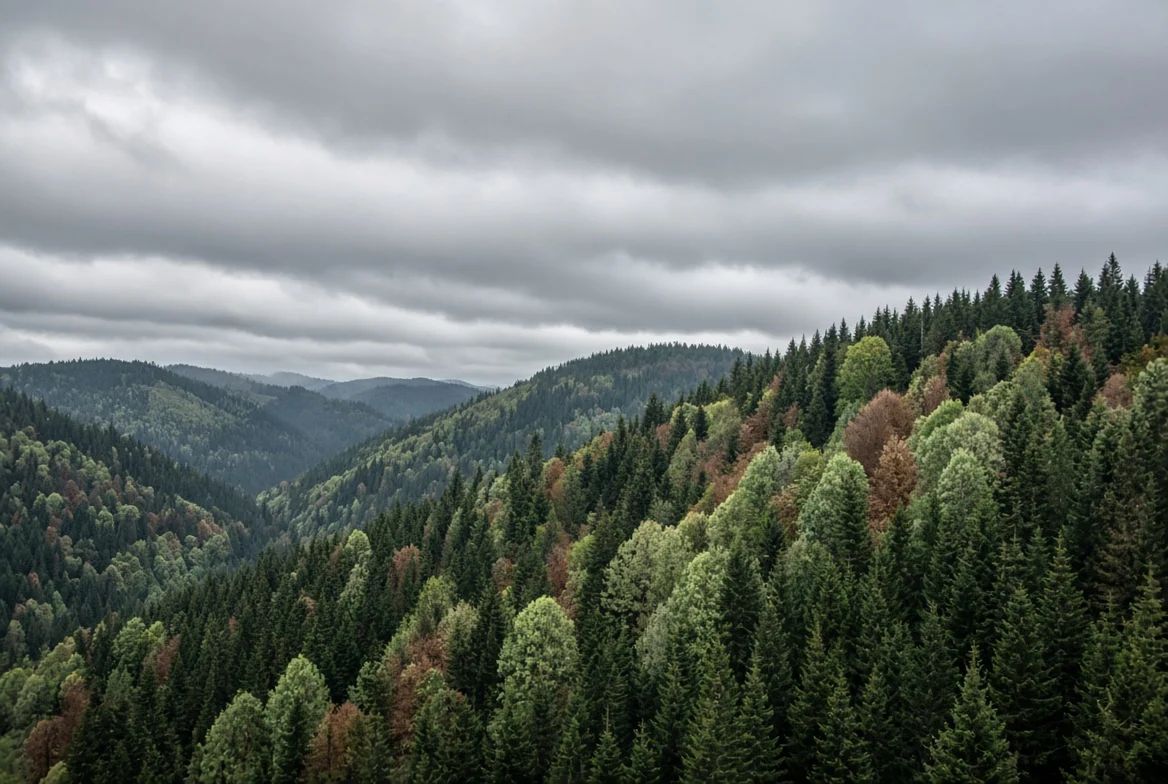
A patch of green fills the map on your phone. Ahead, the path passes between tall trees; a little further on, it opens beside a clearing with young planting. Both places can belong to the same forest parcel. The map shows its area. The age and size of the trees become apparent when we enter the stand itself.
The same distinction helps explain national statistics. Between 2015 and 2024, the recorded area of forest land in the Czech Republic increased from 2,668,392 to 2,683,138 hectares. That is a gain of 14,746 hectares, or about 0.55% of the initial area. Over the same period, recorded standing timber volume fell from 692.6 to 679.4 million cubic metres.
| Measure | 2015 | 2024 | Change |
|---|---|---|---|
| Forest land, ha | 2 668 392 | 2 683 138 | +14 746 |
| Growing stock, million m³ under bark | 692.6 | 679.4 | −13.2 |
Two questions, two measures
Forest-land area answers a question about space: how much land belongs to this category in the cadastral records? The forestry reports describe two contributions to its expansion: afforestation of previously non-forest land and the continuing refinement of cadastral information. The result also reflects the balance between land entering and leaving the forest category.
Growing stock describes another property: the recorded volume of large wood in forest stands, measured under bark. A tall, older stand and an area of young regeneration can contain very different volumes of wood while occupying the same number of hectares. Hectares describe the space; cubic metres describe the timber held in its stands.
The difference between two recorded states
The change in growing stock between 2015 and 2024 was 13.2 million m³, a decrease of approximately 1.91%. The decrease in timber volume therefore occurred alongside a small increase in recorded forest-land area. The two directions of change illustrate how the space assigned to forest and the stands growing within it can develop differently.
An additional point in the series provides useful perspective. The report records 701.1 million m³ for 2020, a higher volume than in either of the two endpoint years. Comparing 2015 with 2024 therefore describes the net difference across nine years. The path between those recorded states had its own dynamics.
Space for another generation
Beside a newly planted clearing, this distinction becomes tangible. Land assigned to forest can remain part of the woodland landscape while another generation of trees begins to grow. Recorded area and timber volume follow different aspects of the same space through different stages of its development.
Species composition, stand age, harvesting and regeneration add further perspectives. Reading them together helps explain how a forest changes. The two basic measures in the forestry reports offer a useful starting point: slightly more recorded forest land and a smaller standing timber volume than in 2015.
Sources and data
Forest-land area comes from the cadastral records of the Czech Office for Surveying, Mapping and Cadastre. Growing stock comes from the administrative forestry records of ÚHÚL/NLI and represents large wood measured under bark. The 2024 stock figure excludes forest with unknown input data. The comparison uses consistent administrative series; differences and percentage changes are our calculations. Each measure retains its original unit.
- Ministry of Agriculture: Report on the State of Forests and Forestry in the Czech Republic in 2015, printed p. 43, Table 4.1.1; p. 49, Table 4.5.1.
- Ministry of Agriculture: Report on the State of Forests and Forestry in the Czech Republic in 2024, printed p. 55, Table 4.1.1; p. 61, Table 4.5.1. Reports are in Czech.
Related story: Forest ecosystem services.