A RESEARCH STORY · 4 MIN READ
Consumer views of game meat: environmental endorsement weakened in 2023
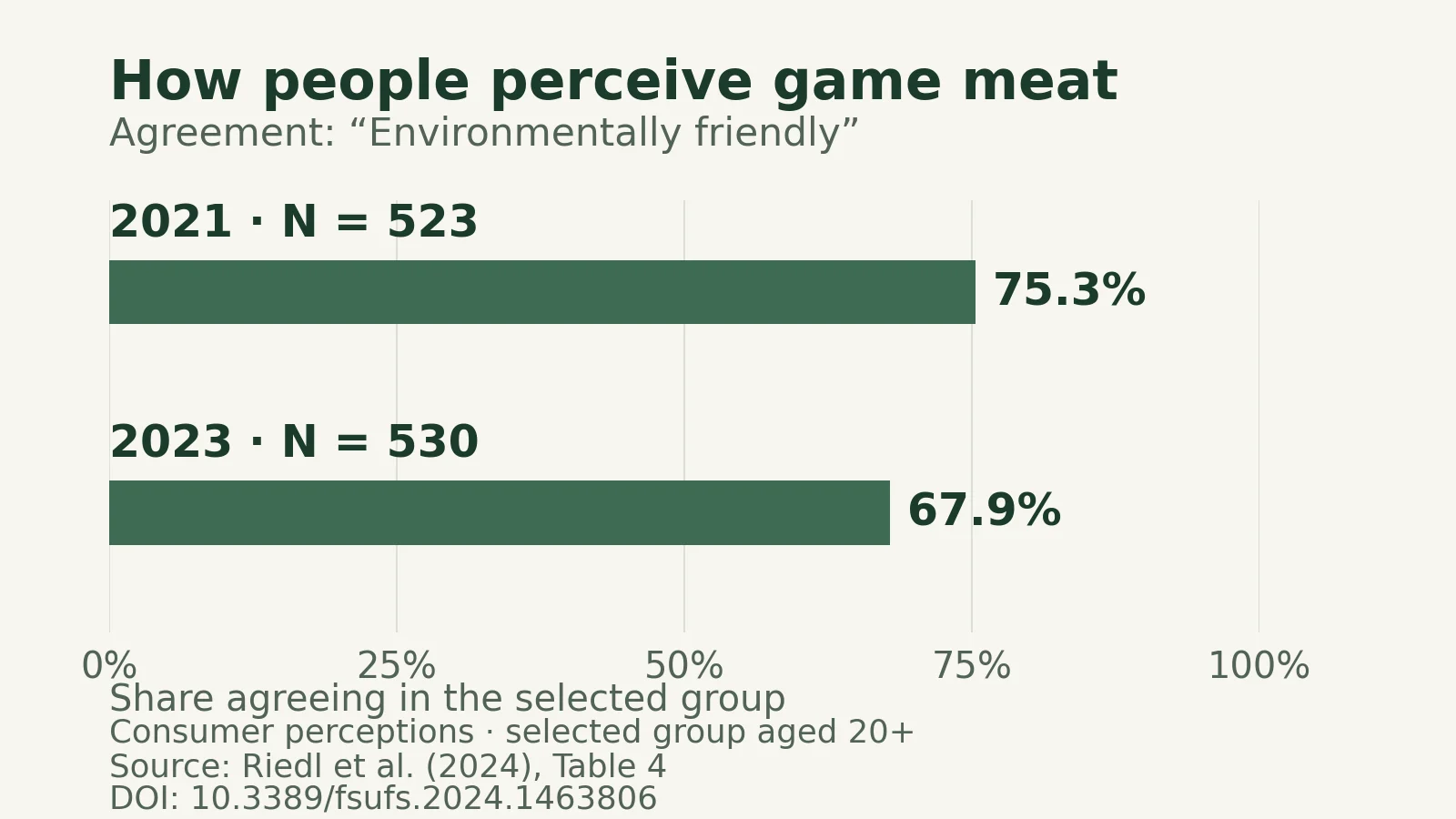
Agreement that game meat is environmentally friendly fell from 75.3% to 67.9%, while definite agreement rose slightly. Two Czech surveys show why the distribution of responses matters when assessing consumer attitudes.

In a Czech consumer survey in 2021, 75.3% of the group studied agreed that game meat was environmentally friendly. In a group selected using comparable criteria in 2023, the share was 67.9%. Most respondents continued to hold a favourable environmental view, while overall agreement fell by 7.4 percentage points.
The response categories reveal a further finding: definite agreement rose from 16.6% to 18.6%. The decline in overall support was accounted for by a lower share selecting “rather agree”. Both the overall proportion of favourable attitudes and their composition changed between the surveys.
Two consumer samples with the same core criteria
The study, published in Frontiers in Sustainable Food Systems in 2024, compared adults aged 20 and over who shared responsibility for household shopping, ate meat and visited restaurants at least twice a month. The sample comprised 523 respondents in 2021 and 530 in 2023.
Both surveys used the same questionnaire and core selection criteria. The comparison describes responses from two consumer samples. Questions measured agreement with statements about health and organic quality, environmental friendliness, and helping Czech forests. The published percentages represent stated opinions about game meat.
Moderate agreement changed most
For environmental friendliness, “rather agree” fell from 58.7% to 49.3%, a decline of 9.4 percentage points. “Rather disagree” rose from 18.8% to 24.2%, while “definitely disagree” increased from 5.9% to 7.9%. The later survey therefore recorded higher shares of definite agreement and both forms of disagreement.
Combining the two agreement categories provides a concise comparison; examining them separately adds precision. Definite agreement rose by 2.0 percentage points, partially offsetting the decline in moderate agreement. The resulting difference in total support was therefore 7.4 points. This describes a change in the distribution of answers between two research samples.
Different statements attracted different support
In 2023, 80.6% agreed with the combined description of game meat as “a healthy food of organic quality”. This percentage applies to the complete statement, which presented health and organic quality together. It records consumers’ assessment of that compound wording.
Agreement with environmental friendliness was 67.9%. The statement that consuming game meat helped Czech forests received 56.9% agreement. The difference between general environmental friendliness and the more specific idea of helping Czech forests was therefore 11.0 percentage points. The health-and-organic-quality statement and the forest-help statement differed by 23.7 points.
The results show that positive descriptions attracted different levels of endorsement within the same sample. A statement about the food’s qualities, a broad environmental description and a claim about the consequence of personal consumption each received support from a different proportion of respondents.
Views about helping Czech forests remained similar overall
Agreement that consuming game meat helped Czech forests was 58.1% in 2021 and 56.9% in 2023. The difference was 1.2 percentage points, substantially smaller than for environmental friendliness. The two assessments therefore changed by different amounts.
The strength of agreement adds detail here too. Definite agreement with helping Czech forests was reported by 9.9% in 2021 and 12.1% in 2023. Moderate agreement accounted for 48.2% and 44.8%, respectively. Similar overall totals were therefore accompanied by a change in the balance between the two agreement categories.
What the detailed breakdown contributes
The findings distinguish three questions: how many people hold a favourable opinion, how definite that opinion is, and which statement it concerns. For environmental friendliness, overall agreement declined while definite support increased slightly. For helping Czech forests, overall agreement remained similar, again with a higher share of definite responses.
Describing public perceptions of game meat therefore requires attention to the exact statement and the distribution of answers. A single aggregate measure of favourable opinion would combine these differences into a less informative result.
Source
Riedl, M., Němec, M., Jarský, V., & Zahradník, D. (2024). Unveiling game meat: an analysis of marketing mix and consumer preferences for a forest ecosystem product. Frontiers in Sustainable Food Systems, 8, 1463806. Data: 2021 and 2023 consumer surveys, Group A, Table 4. DOI 10.3389/fsufs.2024.1463806.
Sources for this story
Frontiers in Sustainable Food Systems
Unveiling game meat: an analysis of marketing mix and consumer preferences for a forest ecosystem product
Riedl, M., Němec, M., Jarský, V., & Zahradník, D. (2024). Unveiling game meat: an analysis of marketing mix and consumer preferences for a forest ecosystem product. Frontiers in Sustainable Food Systems, 8, 1463806. https://doi.org/10.3389/fsufs.2024.1463806
DOI 10.3389/fsufs.2024.1463806