A RESEARCH STORY · 3 MIN READ
Game meat as occasional food: what limits consumption
Game meat’s festive character was cited as a reason for limited consumption by 67.6% of respondents, compared with 30.3% citing price. A 2022 Czech survey also records low repeated consumption and a prominent role for personal contacts in obtaining it.
67.6% of respondents cited game meat’s mainly festive character as a reason for limited consumption, while 30.3% cited its high price. In the 2022 Czech survey, association with special occasions was therefore mentioned more than twice as often as cost. Understanding the market requires attention to the place people assign to game meat in their diet alongside their purchasing power.
The results come from a national survey extension on game meat involving 1,000 respondents. Questions covered consumption frequency, sources of supply and barriers to more frequent use. A detailed account appeared in Forests in 2026; frequency and barriers were also analysed in a 2024 paper in Frontiers in Sustainable Food Systems.
About one in eight reported repeated consumption
In total, 40.3% reported at least occasional consumption. This comprised 28.5% who ate game meat once or twice a year and 11.8% who consumed it repeatedly. The remaining 59.7% reported no consumption. Occasional consumers therefore outnumbered repeated consumers by more than two to one.
Consumption also differed by species. Wild boar was consumed at least occasionally by 30.4% of respondents, roe deer by 25.7% and red deer by 20.1%. These percentages describe experience with individual species. They give the broad category of game meat more specific meaning: respondents encountered different types to different degrees.
Barriers overlap
Alongside festive use, respondents cited dislike of the taste (33.6%), preparation difficulty (31.2%), price (30.3%) and uncertainty about where to buy game meat (29.5%). Percentages refer to the full sample, and respondents could select multiple barriers. The same person could therefore report difficulty with preparation and access, for example.
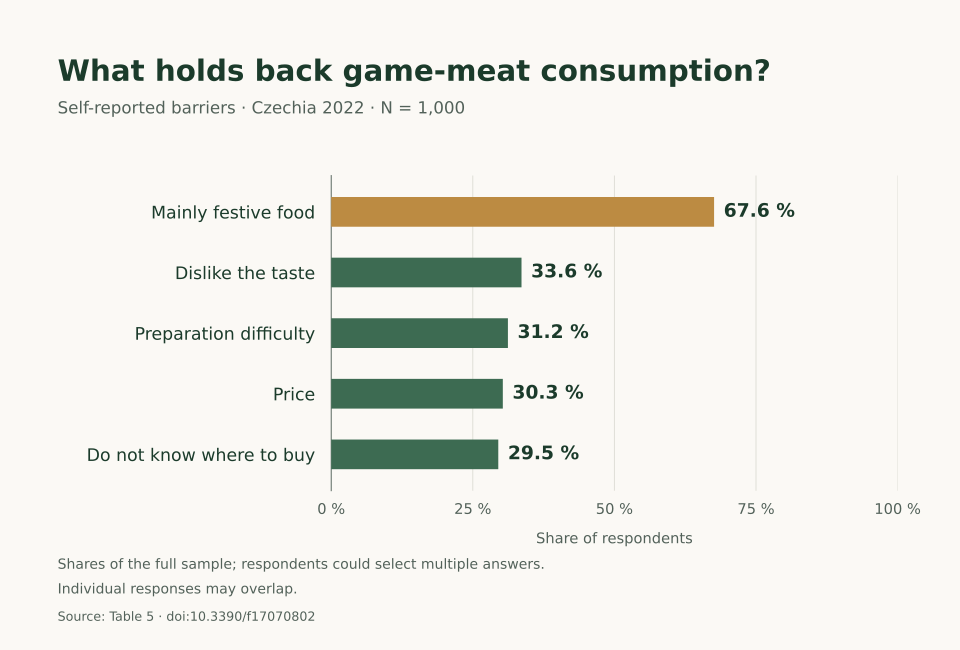
The ranking identifies several distinct issues: fitting the food into established eating patterns, evaluating its taste, preparing it and accessing a supplier. Each percentage measures how often a reason was selected. Together, they describe the composition of perceived barriers to more frequent consumption.
Personal contacts reach further than individual retail channels
Friends, acquaintances, hunters or personal hunting were reported as a source by 33.2% of all respondents. Fresh purchases from shops were reported by 8.9%, and frozen purchases by 5.2%. Each figure uses the same denominator of 1,000 respondents. Personal connections and hunting therefore reached a considerably larger share than either of the retail forms measured.
This pattern gives context to uncertainty about where to buy game meat. A substantial part of its use involved direct relationships. Understanding availability therefore requires attention to the route by which a product reaches the consumer.
Procurement and prepared cuts occupy different stages
The 2026 study illustrates price differences along the chain using wild boar. It applies a primary procurement price of EUR 1.52/kg. Selected prices from a processor’s direct-sales list were approximately EUR 8/kg for stew meat, EUR 14/kg for boneless leg and EUR 17/kg for boneless loin. These are examples from the study’s source material and concern different product forms.
Cutting, trimming, weight losses, cooling, inspection, packaging, labour and distribution intervene between these stages. Prepared-cut prices also include commercial costs and margins. The spread between procurement and sale therefore reflects both processing and differences in the sales value of individual cuts.
Interviews with landowners and processors in Czechia and Slovakia during 2022–2024, published in Foods in 2025, add evidence on processing capacity, seasonal supply and costs. Consumer responses and suppliers’ accounts together identify where conditions for more regular use of game meat arise along the chain.
Sources
Riedl et al. (2026), Forests 17(7), 802, Table 5 and Section 3.3. DOI 10.3390/f17070802. Riedl et al. (2024), Frontiers in Sustainable Food Systems 8, 1463806, Tables 2–3. DOI 10.3389/fsufs.2024.1463806. Němec et al. (2025), Foods 14(4), 653. DOI 10.3390/foods14040653.
Sources for this story
Forests
Supply, Trade and Consumption of Major Forest Foods in Czechia: Mushrooms, Forest Fruits and Game Meat
Riedl, M., Němec, M., Jarský, V., & Sloup, R. (2026). Supply, Trade and Consumption of Major Forest Foods in Czechia: Mushrooms, Forest Fruits and Game Meat. Forests, 17(7), 802. https://doi.org/10.3390/f17070802
DOI 10.3390/f17070802Foods
Consumer Perceptions and Sustainability Challenges in Game Meat Production and Marketing: A Comparative Study of Slovakia and the Czech Republic
Němec, M., Riedl, M., Šálka, J., Jarský, V., Dobšinská, Z., Sarvaš, M., Sarvašová, Z., Bučko, J., & Hustinová, M. (2025). Consumer Perceptions and Sustainability Challenges in Game Meat Production and Marketing: A Comparative Study of Slovakia and the Czech Republic. Foods, 14(4), 653. https://doi.org/10.3390/foods14040653
DOI 10.3390/foods14040653Frontiers in Sustainable Food Systems
Unveiling game meat: an analysis of marketing mix and consumer preferences for a forest ecosystem product
Riedl, M., Němec, M., Jarský, V., & Zahradník, D. (2024). Unveiling game meat: an analysis of marketing mix and consumer preferences for a forest ecosystem product. Frontiers in Sustainable Food Systems, 8, 1463806. https://doi.org/10.3389/fsufs.2024.1463806
DOI 10.3389/fsufs.2024.1463806Forests
Analysis of consumer attitudes as an important tool for the segmentation and development of the game market in the Czech Republic
Němec, M., Riedl, M., Jarský, V., & Dudík, R. (2023). Analysis of consumer attitudes as an important tool for the segmentation and development of the game market in the Czech Republic. Forests, 14(3), Article 450. https://doi.org/10.3390/f14030450
DOI 10.3390/f14030450Journal of Forest Science
The factors limiting the venison market in the Czech Republic and options for limiting their impact on the Forestry
Němec, M., Skřivánková, A., Vaca, D., Novák, J., Riedl, M., Dudík, R., & Jarský, V. (2023). The factors limiting the venison market in the Czech Republic and options for limiting their impact on the Forestry. Journal of Forest Science, 69(3), 101-113. https://doi.org/10.17221/142/2022-jfs
DOI 10.17221/142/2022-jfs