A RESEARCH STORY · 2 MIN READ
Thirty years of foraging: 25–60 million kilograms a year, with little long-term change
The quantity of mushrooms and forest berries gathered by Czech households varies sharply from year to year. The 1994–2023 series nevertheless shows a broadly stable long-term level and an estimated value of billions of crowns.
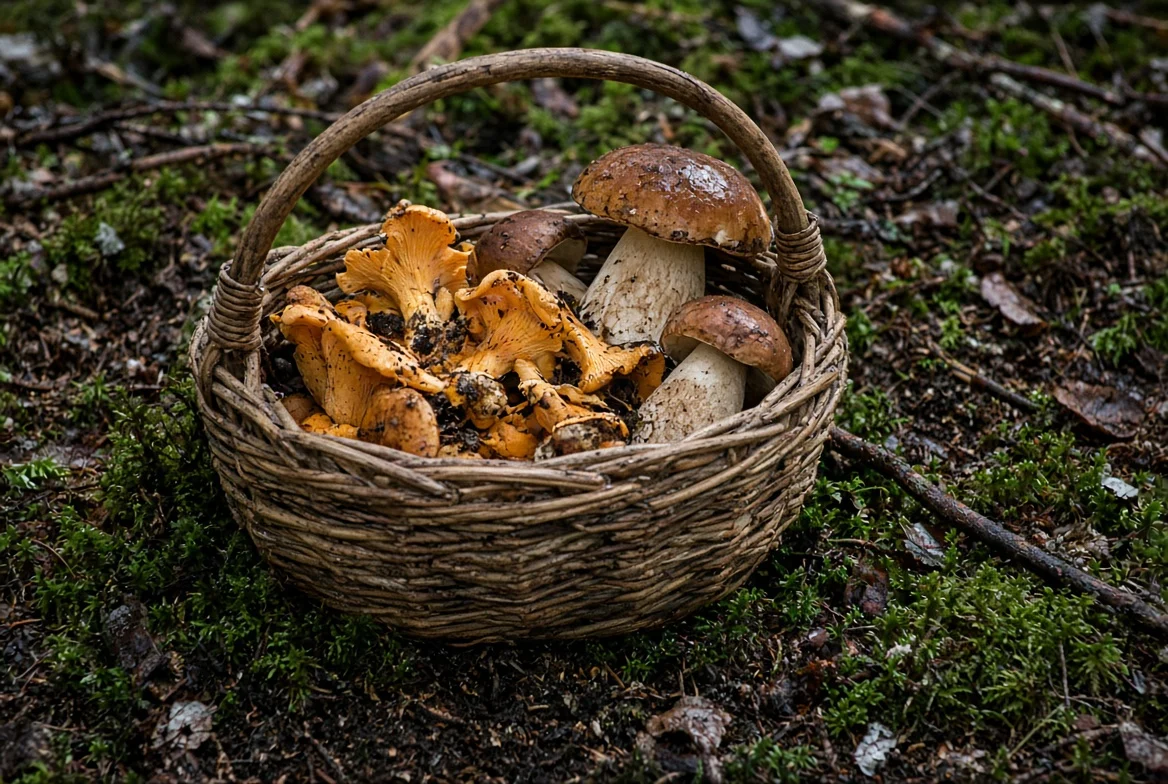
The estimated annual quantity of mushrooms and forest berries gathered in Czechia ranged from approximately 25 to 60 million kilograms between 1994 and 2023. Despite a more than twofold difference between poor and abundant seasons, the long-term level remained almost constant. A study by Marcel Riedl, Martin Němec and Vilém Jarský, published in Forests in 2024, describes an activity that retained its scale for three decades while individual seasons differed substantially.
What thirty seasons reveal
The authors fitted a line with a slight downward slope to the time series. They describe the decline as insignificant, and the line accounts for only a small part of the variation between years. The main finding is therefore the sustained importance of gathering. A particularly good or poor season provides limited evidence about the long-term direction.
The total collected depends on several conditions operating together. Available crops matter, alongside how many people gather, how often they go and how much they bring back. In their discussion, the authors identify weather, incomes, leisure time and changes in forest environments as possible parts of the explanation. The time series alone cannot establish each factor's contribution to a particular annual fluctuation.
Consistent core questions after the season
The programme centres on annual questionnaire surveys, involving at least 1,000 respondents selected using quotas for major population characteristics. Fieldwork took place in November and December, after the gathering season. The core questions date back to 1994, with additional topics introduced over time. This provides a basis for comparing years through consistently defined questions.
For quantities, the questionnaire explicitly asks respondents to include their whole household's collection. It covers mushrooms, bilberries, raspberries, blackberries, elderberries and cowberries. The national total is an estimate derived from respondents' reports. It measures what households obtained; the method does not measure everything that grew in the forests.
How the economic value is calculated
Economic valuation multiplies the quantity of each product by its corresponding market price. The study's table expresses values for 2019–2022 in 2022 prices, reducing the influence of changing price levels on the comparison. Estimated annual values over these four years ranged from approximately CZK 6.2 billion to CZK 8.6 billion.
| Year | Quantity (million kg) | Value (billion CZK) |
|---|---|---|
| 2019 | 31.915 | 6.344 |
| 2020 | 42.549 | 8.564 |
| 2021 | 35.217 | 6.222 |
| 2022 | 38.956 | 7.828 |
This calculation expresses the value of the products obtained when priced at market rates. For households, it may represent food they supply themselves. Cash income would arise through any subsequent sale. It represents the gross value of the products before deducting gatherers' time, transport and processing costs.
Its scale alongside forestry income
For 2019–2022, the estimated value of gathering was equivalent to approximately 37% of the net income from traditional forestry used by the authors as a comparator. This compares the scale of two differently defined measures: the gross value of gathered products and forestry's net income.
The result shows the scale of value that forest use provides directly to households. Economic assessments of forests can account for this contribution to household provisioning alongside income from timber production. The thirty-year series adds an essential time dimension: the multibillion-crown valuation rests on an activity that remains substantial over the long term while varying considerably between individual seasons.
Sources for this story
Forests
Thirty Years of Research on Ecosystem Services: The Socio-Economic Role of Forest Visits and Foraging in Enhancing Human Well-Being
Riedl, M., Němec, M., & Jarský, V. (2024). Thirty Years of Research on Ecosystem Services: The Socio-Economic Role of Forest Visits and Foraging in Enhancing Human Well-Being. Forests, 15(11), 1845. https://doi.org/10.3390/f15111845
DOI 10.3390/f15111845