A RESEARCH STORY · 4 MIN READ
Forest use in 2020: more frequent visits and more gathering households
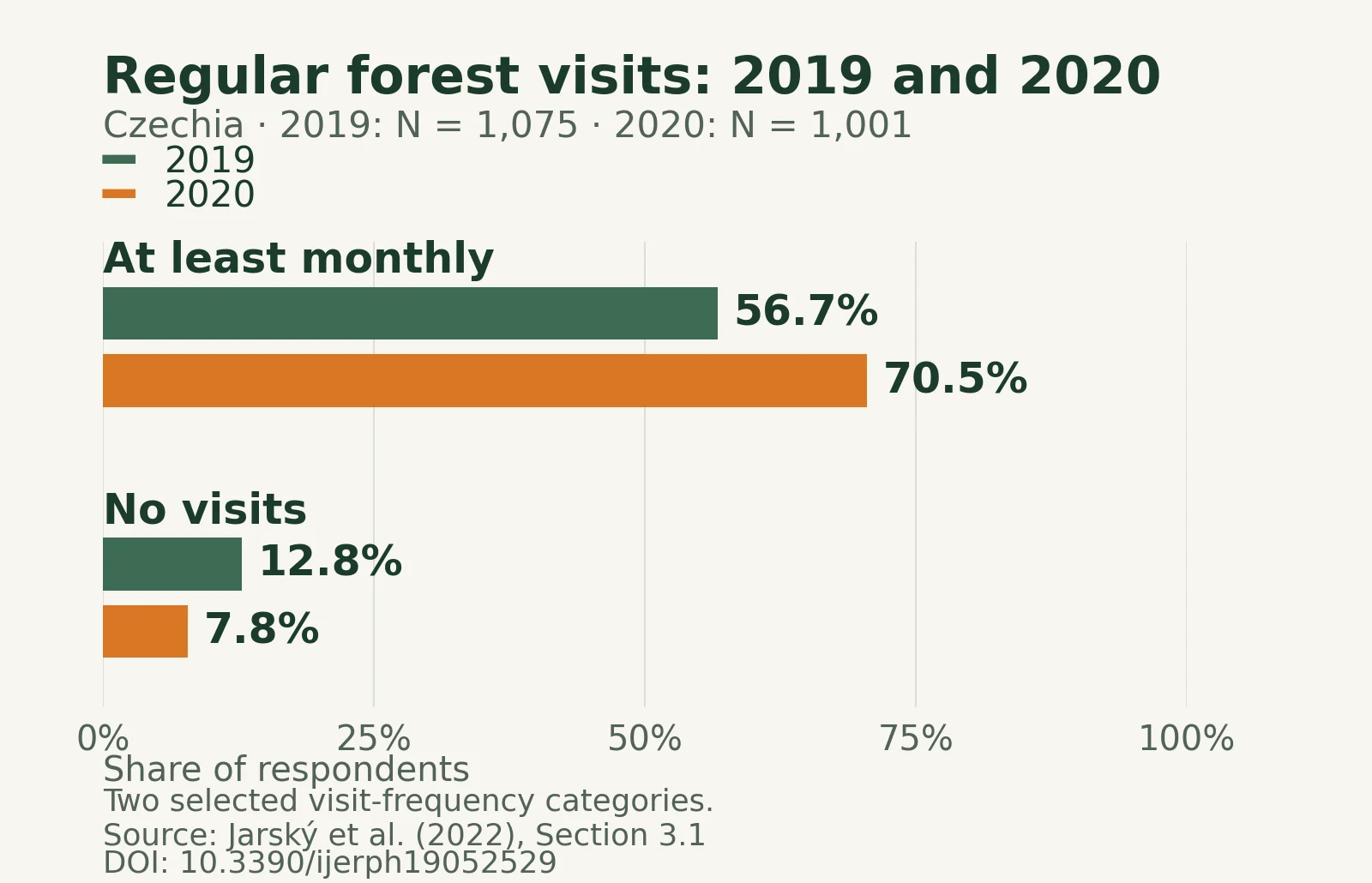
The share visiting a forest at least monthly rose from 56.7% to 70.5%. More households gathered mushrooms, while the average harvest per gathering household fell. National surveys are complemented by local visitor counts.
In 2020, 70.5% of respondents in a Czech survey reported visiting a forest at least once a month, compared with 56.7% a year earlier. The increase of 13.8 percentage points represents a relative rise of approximately one quarter. During the same period, the share of households gathering mushrooms and bilberries increased substantially, while the average quantity per gathering household fell.
Vilém Jarský and colleagues published the findings in 2022. The study combined several forms of observation: national questions about visits and gathering, another survey addressing motivations for visiting, and automated counts in a selected area of Central Bohemia. The datasets capture different aspects of forest use.
Visits became more regular
The visit-frequency survey included 1,075 respondents in 2019 and 1,001 in 2020. Alongside the increase in at-least-monthly visits, the share reporting no visits fell from 12.8% to 7.8%. The share making more regular visits therefore grew as the share with no forest visits declined.
The 2020 fieldwork ran from 20 November to 5 December, capturing experience through most of the year. It used an established visit-frequency question also asked before the pandemic. Responses from the two years were therefore obtained through comparable procedures.
Local counters recorded a 52% increase
Three counters near Jevany, Oplany and Kachní louže, around Kostelec nad Černými lesy, recorded walkers and cyclists and their direction of movement. They registered 57,236 passages in 2019 and 86,742 in 2020. The difference was 29,506 records, approximately 52% of the earlier total.
The counts include repeated passages by the same people and describe traffic on specific paths. While the questionnaire records an individual’s reported visit frequency, a counter records movement at a particular location. The local increase of 52% therefore applies to the monitored sites.
Attendance was associated with restriction periods and weather
Higher attendance was especially evident from March to May and again in autumn, coinciding with periods when other activities were heavily restricted. Researchers matched daily counts with temperature and rainfall data from the nearby Ondřejov station. Higher temperatures were associated with greater attendance, rainfall with lower attendance.
The association between higher attendance and restrictions also appeared in statistical models including weather. Several types of restriction operated during similar periods. The results therefore describe temporal associations amid several simultaneous changes in leisure opportunities.
More gathering households, smaller harvests per household
The reported share of households gathering mushrooms rose from 65.12% in 2019 to 83.52% in 2020. Meanwhile, the average quantity per gathering household fell from 8.20 to 7.04 kilograms. Wider participation thus coincided with smaller average harvests among participating households.
Bilberries followed a similar pattern. The share of gathering households rose from 35.63% to 65.23%, while the quantity per gathering household fell from 3.74 to 2.96 kilograms. For each product, the average covers only households that gathered it. Gathering responses concerned the whole household; visit frequency concerned the individual respondent.
Three indicators describe different changes
The share of visitors, the number of recorded passages and the quantity acquired by a household have different denominators. Distinguishing them gives a more precise account of 2020: a larger share of respondents visited regularly, the monitored paths recorded more traffic, and more households participated in gathering.
For recreational forest management, the combination of wider participation and greater local traffic is particularly relevant. National surveys describe public participation, counters identify traffic at specific locations, and harvest quantities record the use of forest foods. Each indicator contributes different information to planning and monitoring recreational use.
Source
Jarský, V.; Palátová, P.; Riedl, M.; Zahradník, D.; Rinn, R.; Hochmalová, M. (2022). Forest Attendance in the Times of COVID-19—A Case Study on the Example of the Czech Republic. International Journal of Environmental Research and Public Health, 19(5), 2529. Sections 2.1.1 and 3.1–3.3, Tables 2–4, Figure 5. DOI: 10.3390/ijerph19052529.
Sources for this story
International Journal of Environmental Research and Public Health
Forest Attendance in the Times of COVID-19—A Case Study on the Example of the Czech Republic
Jarský, V., Palátová, P., Riedl, M., Zahradník, D., Rinn, R., & Hochmalová, M. (2022). Forest Attendance in the Times of COVID-19—A Case Study on the Example of the Czech Republic. International Journal of Environmental Research and Public Health, 19(5), 2529. https://doi.org/10.3390/ijerph19052529
DOI 10.3390/ijerph19052529