A RESEARCH STORY · 4 MIN READ
Over a third of respondents report both gathering and buying forest fruits
Czech surveys from 2021–2025 indicate that approximately 37.2% of respondents reported both household forest-fruit collection and purchase. Gathering and purchasing complement each other in this food category. Mushrooms have a stronger self-provisioning profile.
Approximately 37.2% of respondents reported that their household both gathered and bought forest fruits. This share is calculated from Czech survey results covering 2021–2025. It shows a substantial overlap between self-provisioning and market purchasing: households with their own harvest also form part of the customer base.
The study, published in Forests in 2026, combined responses from 5,025 adults. Each respondent reported quantities acquired by the entire household. The authors defined participation in collection or purchase as any positive annual quantity. The percentages therefore describe how widely each acquisition route was used; separate quantity measures describe its intensity.
Measuring the overlap
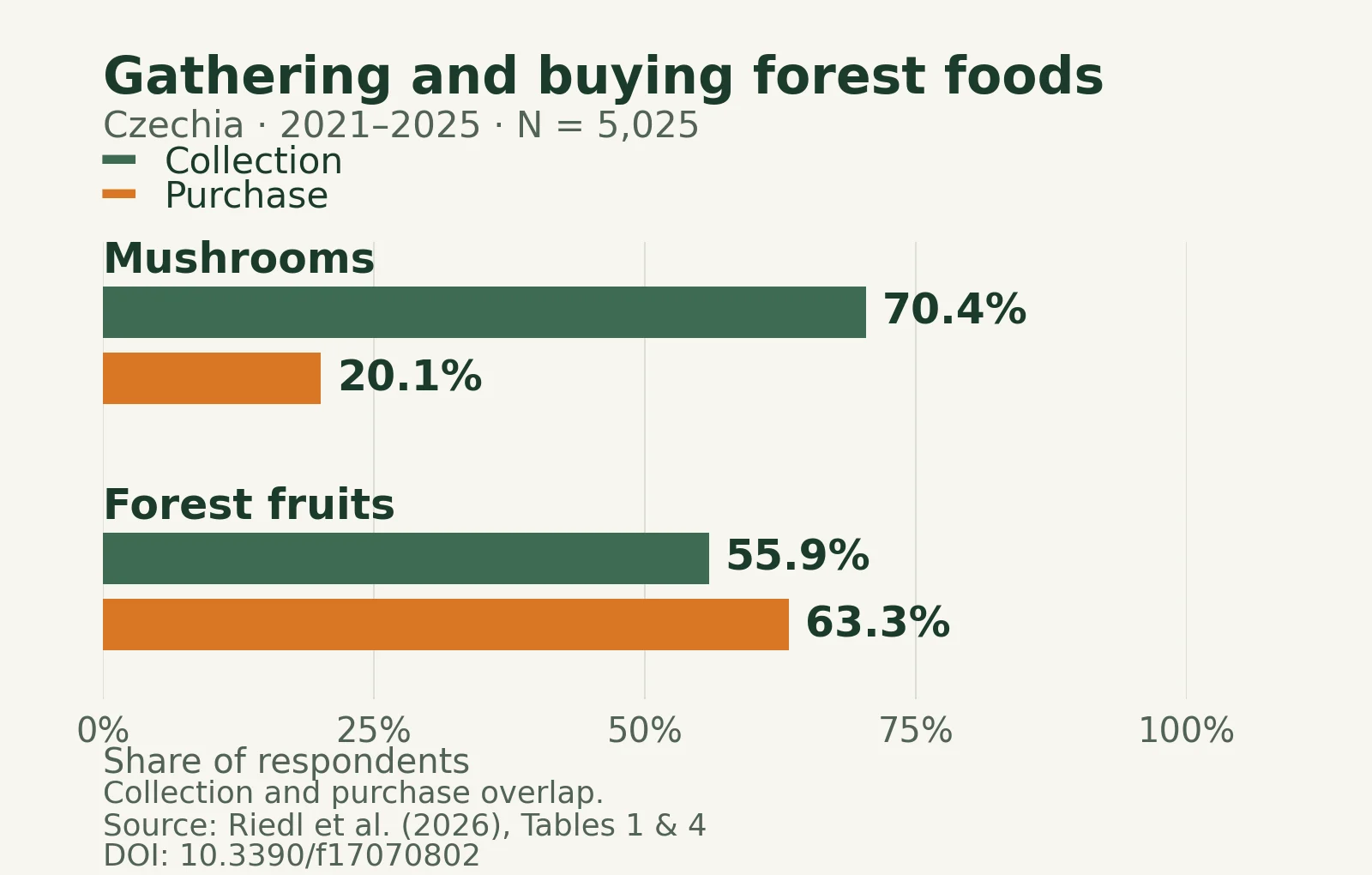
Forest-fruit collection was reported by 55.9% of respondents, while 63.3% reported purchases of fresh, chilled or frozen fruit. At least one of these routes was used by 82.0%. Their intersection can be calculated as 55.9 + 63.3 − 82.0 = 37.2%. This is our approximate calculation from the published rounded figures.
Adding the collection and purchase shares counts the overlapping group twice. Subtracting everyone who reported at least one acquisition route leaves that shared group. The calculation distinguishes the prevalence of the two activities from the number of households using either of them.
The authors also examined the relationship using an odds ratio. Respondents reporting household forest-fruit collection had higher odds of purchase than the others, with a ratio of 1.39. The study interprets this association as complementarity between the two routes. It describes their relationship in the responses; the specific reasons behind individual purchases remain a separate research question.
Product form adds another distinction
Fresh or chilled forest-fruit purchases were reported by 56.3% of respondents and frozen purchases by 29.1%. At least one of these forms was purchased by 63.3%. The difference between the sum of the individual forms and their combined share corresponds to households using both forms of purchase.
Tracking product forms separately adds another level to the analysis. A household may combine gathering with purchasing and also buy several forms of the same food category. Assessing market participation therefore requires clarity about whether a figure counts individual forms, all purchasers or households that also gather. Each measure answers a different question.
Mushroom acquisition is centred on gathering
Mushroom collection was reported by 70.4% of respondents and purchase by 20.1%. The odds ratio for purchase among households with and without collection was 0.92, close to one. Gathering and purchasing mushrooms were thus approximately independent in the results.
Purchase shares for individual forms were also substantially lower than for forest fruits: fresh or chilled mushrooms were reported by 16.8% of respondents and frozen mushrooms by 6.3%. Mushrooms and forest fruits therefore represent different provisioning patterns. The former is strongly centred on gathering, while the latter combines collection with more widespread market purchasing. Grouping them under a single “forest foods” category can obscure that distinction.
Settlement size matters more for mushroom gathering
In places with fewer than 5,000 inhabitants, 75.9% of respondents reported household mushroom collection. In cities with at least 90,000 inhabitants, the share was 64.5%, a difference of 11.4 percentage points. Forest-fruit purchasing showed the opposite pattern: 61.0% in the smallest settlements and 69.5% in the largest cities.
Forest-fruit collection itself varied less across settlement sizes. The shares in those two extreme categories were 57.1% and 53.8%. The authors describe its prevalence as comparatively stable. Overall, settlement associations were modest, with mushroom gathering showing the clearer contrast.
Examining the product, acquisition route and settlement size together provides a more precise picture of household provisioning. Assessments of forest foods benefit from measuring both gathered supplies and household participation in markets. Their overlap is a substantial part of the result, especially for forest fruits.
Source
Riedl, M., Němec, M., Jarský, V., & Sloup, R. (2026). Supply, Trade and Consumption of Major Forest Foods in Czechia: Mushrooms, Forest Fruits and Game Meat. Forests, 17(7), 802. Tables 1, 2 and 4; Sections 3.1 and 3.2. DOI: 10.3390/f17070802.
Sources for this story
Forests
Supply, Trade and Consumption of Major Forest Foods in Czechia: Mushrooms, Forest Fruits and Game Meat
Riedl, M., Němec, M., Jarský, V., & Sloup, R. (2026). Supply, Trade and Consumption of Major Forest Foods in Czechia: Mushrooms, Forest Fruits and Game Meat. Forests, 17(7), 802. https://doi.org/10.3390/f17070802
DOI 10.3390/f17070802