A RESEARCH STORY · 3 MIN READ
Where does Czech timber go? Nearly two thirds of exports head to Austria
Austria received nearly 64% of Czech raw timber exports by volume in 2024; China accounted for 2.2%. The Forestry Green Report maps strong links with neighbouring countries and substantial imports into Czechia.
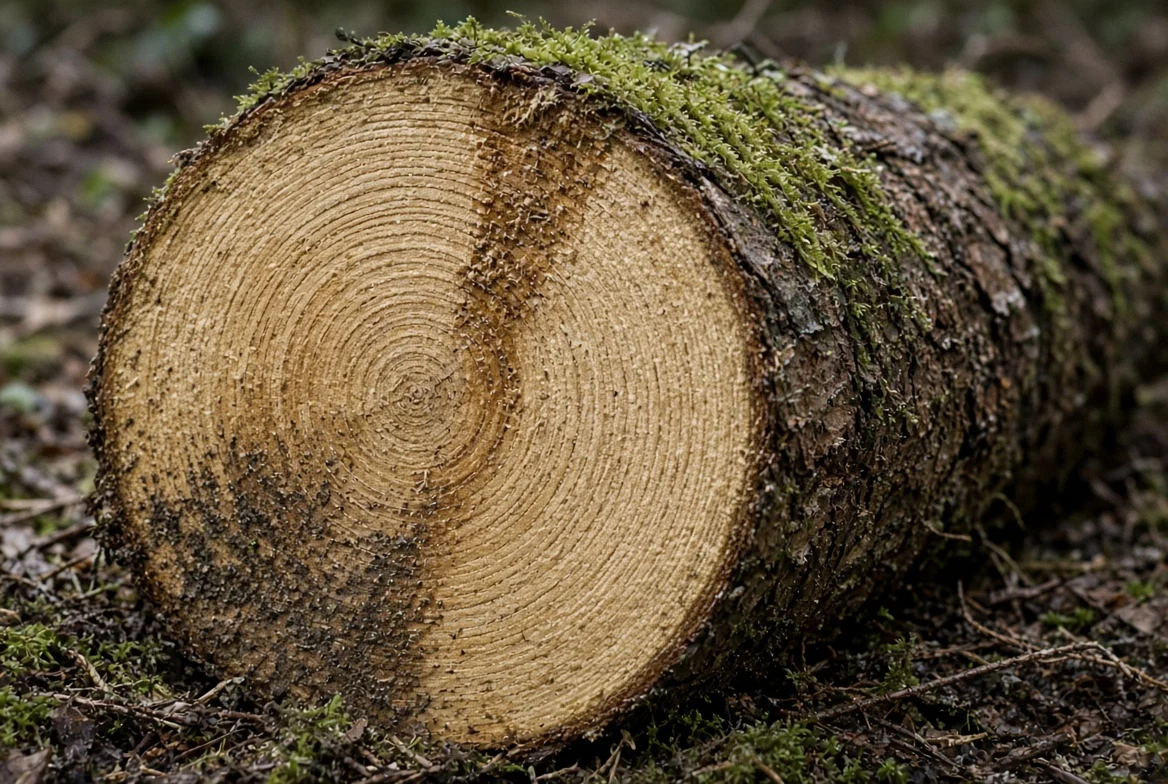
Logs are stacked beside a forest track, ready for collection. From the walking path, their onward journey usually disappears from view. Some go to customers in Czechia; others cross a border. The Forestry Green Report for 2024 traces that second journey at national scale.
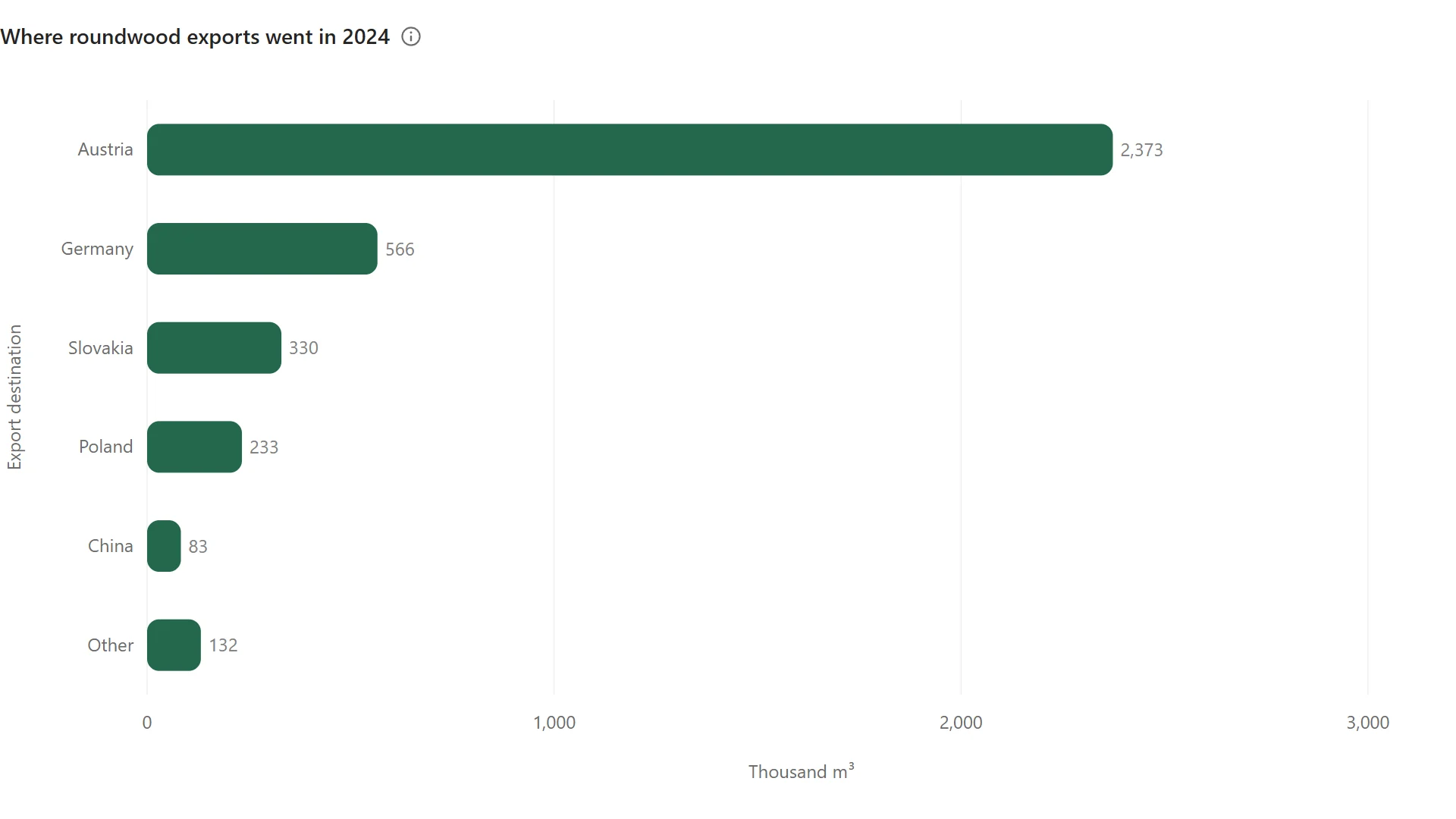
Preliminary figures record 3.717 million cubic metres of raw timber exported from Czechia. Austria received 2.373 million m³, approximately 63.8% of the total volume. For every hundred cubic metres exported, nearly sixty-four went to this one neighbouring country.
Neighbours dominate the trade map
Germany was another major destination, receiving 566,000 m³. Slovakia followed with 330,000 m³ and Poland with 233,000 m³. Together, the four neighbouring countries received 3.502 million m³, about 94.2% of recorded exports. Their share gives the trade in this raw material a distinctly Central European geography.
Exports to China amounted to 83,000 m³, approximately 2.2% of total volume. Seen together, the destinations reveal the scale of trading relationships across the nearest borders. All shares in this comparison are calculated from cubic metres.
Cubic metres and crowns tell different parts of the story
Total raw timber exports were valued at CZK 9.248 billion. Austria accounted for CZK 5.638 billion, approximately 61% of export value. Austria's volume share of 63.8% and value share of 61% describe two different aspects of the same trade.
The average recorded value per exported cubic metre was CZK 2,488; for deliveries to Austria, it was CZK 2,376. Each average combines the particular mix of assortments delivered. The table allows comparisons between trade aggregates in consistent units. A more detailed assessment would follow individual products, their quality and other conditions of sale.
Timber also flows into Czechia
In the same year, Czechia imported 2.371 million m³ of raw timber. Exports exceeded imports by 1.346 million m³. Supplies came from countries including Slovakia, Germany and Poland, which also appear among the destinations for Czech exports.
The trade map therefore has arrows pointing in both directions. It offers readers a tangible continuation of a forest story: harvested raw material enters a network of cross-border deliveries in which neighbouring countries play a substantial role. A stack of logs beside a woodland track is also the beginning of a regional economic story.
Destinations in numbers
| Destination | Volume, thousand m³ | Volume share, % |
|---|---|---|
| Austria | 2,373 | 63.8 |
| Germany | 566 | 15.2 |
| Slovakia | 330 | 8.9 |
| Poland | 233 | 6.3 |
| China | 83 | 2.2 |
| Other countries | 132 | 3.6 |
Sources and data
Preliminary 2024 figures. Raw timber is defined by the commodity codes listed in the report and includes sawlogs, pulpwood and fuelwood. Destinations describe recorded international trade. Volume shares and the total for the four neighbouring countries are our calculations.
- Ministry of Agriculture: Report on the State of Forests and Forestry in the Czech Republic in 2024, printed p. 98, section 7.1.2 and Table 7.1.2.1. Table sources: Czech Statistical Office and Ministry of Agriculture. Report in Czech.
Related story: Timber construction and building height.