A RESEARCH STORY · 4 MIN READ
Timber housing by life stage: support highest among empty nest respondents
Positive attitudes towards timber housing were reported by 57.1% of empty nest respondents and 37.3% of students. The MML 2024 survey also reveals differences in the priority given to construction speed, energy efficiency, appearance and sustainability.
The highest share of positive attitudes towards timber housing in a Czech survey was recorded among respondents in the “empty nest” stage, whose children had become independent: 57.1%. Among students, 37.3% held a positive view. The difference was 19.8 percentage points, showing a substantial variation in acceptance across life-role groups.
Specific priorities also differed. Young parents selected construction speed among their leading criteria almost three times as often as students. Sustainability was selected most frequently by parents of older children. Price remained a prominent concern across life roles.
Attitudes and priorities in the same survey
The study, published in 2025, included the MML survey of 3,500 respondents conducted in the final quarter of 2024. Its life-role classification combined age with family and economic circumstances. Categories included students, young parents, parents of older children and empty nest respondents.
One question measured overall attitudes towards timber housing on a scale from very positive to very negative. Another recorded stated priorities when choosing a timber building. Respondents could select up to three of eight attributes: safety, price, durability, sustainability, energy efficiency, appearance, references and construction speed. Percentages for this question indicate how often an attribute appeared among the priorities of each group.
Neutral attitudes accounted for a substantial share
Across the full sample, 48.4% held a positive view, 42.8% a neutral view and 8.7% a negative view. Positive ratings reached 51.9% among young parents. Among students, neutral was the most frequent response, selected by 50.7%. Their lower share of positive views was therefore accompanied primarily by a high proportion of neutral ratings.
These results describe respondents’ opinions within one survey wave. The proportion of positive ratings measures acceptance of timber housing as a form of construction. An actual purchase is a separate decision involving specific properties, financing and a need to change housing.
Speed and energy efficiency receive different emphasis
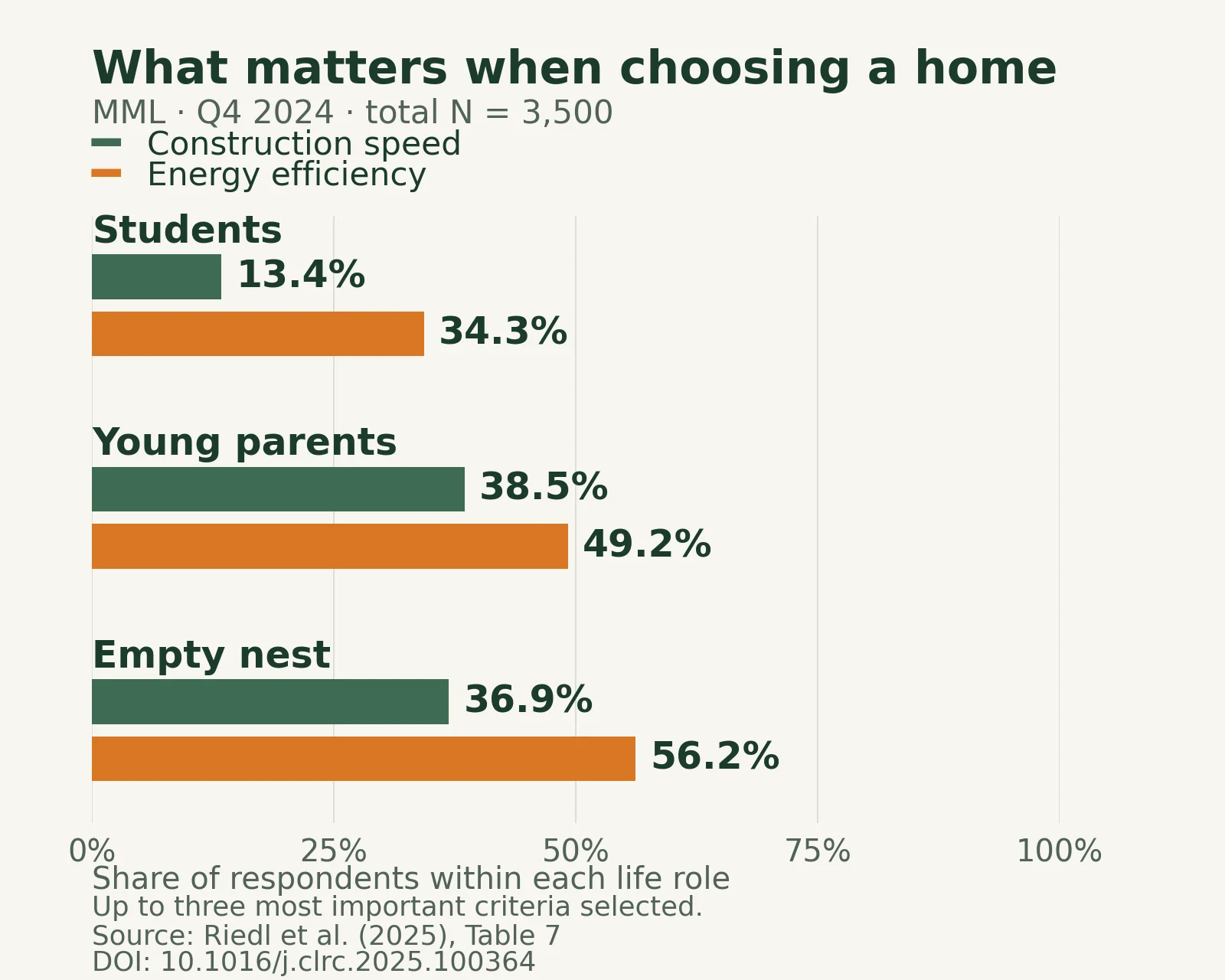
Construction speed was selected by 13.4% of students, 38.5% of young parents and 36.9% of empty nest respondents. The gap between young parents and students was 25.1 percentage points. Within these three groups, speed was therefore an attribute with a marked difference in how frequently it was prioritised.
Energy efficiency was selected by 34.3% of students, 49.2% of young parents and 56.2% of empty nest respondents. For the last group, it was a more frequent priority than construction speed. Both attributes concern practical features of a building, but their ranking and prominence differed across groups.
Appearance and sustainability follow another pattern
Appearance was a leading criterion for 29.5% of students and 16.7% of young parents. The direction of this difference was the reverse of that for construction speed. Students more often prioritised aesthetics, while young parents more often prioritised completion speed.
Sustainability reached its highest share across all the groups among parents of older children, at 32.4%. Among students, 22.1% selected it. The distribution shows that environmental priorities were associated with life roles differently from aesthetic priorities. Each attribute produced its own ordering of groups.
Price provides a common foundation
Price was selected by 62.4% of students, 66.1% of young parents and 66.5% of empty nest respondents. These differences were substantially smaller than those for speed or energy efficiency.
Breaking down the results by life role therefore adds precision to the overall measure of support for timber housing. It identifies both shared requirements and specific differences between respondents. Acceptance of the same construction approach can accompany different priorities for energy performance, speed and appearance. That structure is obscured when only the overall share of favourable opinions is considered.
Source
Riedl, M., Němec, M., Neužilová, L., Jarský, V., & Dudík, R. (2025). Consumer attitudes toward timber housing in the Czech Republic: Drivers and barriers for cleaner and responsible consumption transitions. Cleaner and Responsible Consumption, 19, 100364. Data: MML 2024, Tables 5 and 7. DOI 10.1016/j.clrc.2025.100364.
Sources for this story
Cleaner and Responsible Consumption
Consumer attitudes toward timber housing in the Czech Republic: Drivers and barriers for cleaner and responsible consumption transitions
Riedl, M., Němec, M., Neužilová, L., Jarský, V., & Dudík, R. (2025). Consumer attitudes toward timber housing in the Czech Republic: Drivers and barriers for cleaner and responsible consumption transitions. Cleaner and Responsible Consumption, 19, 100364. https://doi.org/10.1016/j.clrc.2025.100364
DOI 10.1016/j.clrc.2025.100364