A RESEARCH STORY · 3 MIN READ
Frequent forest visits: approximately 70% of adults in Czechia and 25% in Slovakia
Surveys from 2020–2024 reveal substantial differences in forest visitation and gathering. Participation is more widespread in Czechia, while active Slovak gatherers report larger annual quantities of mushrooms and forest fruits per person.
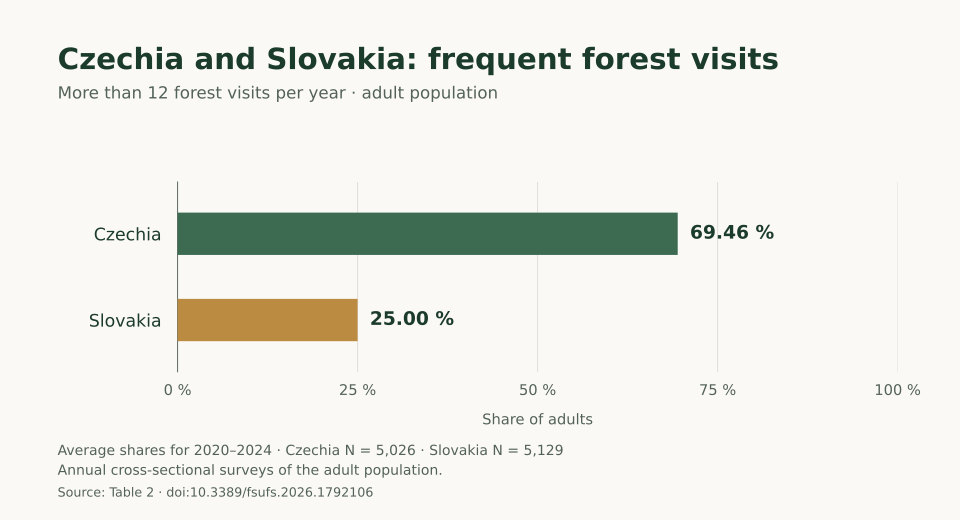
More than twelve forest visits per year were reported by 69.46% of Czech adult respondents and 25.00% of Slovak respondents. Surveys from 2020–2024 reveal a substantial difference between two neighbouring countries with closely connected histories. Slovakia also has the higher forest cover in the figures cited by the study: approximately 41%, compared with 34.8% in Czechia.
Published in Frontiers in Sustainable Food Systems, the study analysed 5,129 Slovak and 5,026 Czech respondents. A new adult sample was selected each year. A shared personal-interview method and harmonised questions allowed visitation frequency and gathering participation to be compared over the same five-year period.
The clearest difference is in regular visitation
Occasional visits, defined as no more than twelve per year, predominated in Slovakia, where they were reported by 47.46% of respondents. The Czech share was 20.31%. No forest visit in the preceding twelve months was reported by 27.55% of Slovak respondents and 10.23% of Czech respondents.
The contrast therefore extends across the visitation distribution. Frequent returns dominate the Czech responses, while occasional visits or no visits have greater weight in Slovakia. The share visiting at least once and the share visiting frequently describe different aspects of forest use.
Wider participation in Czechia, larger harvests among active Slovak gatherers
Mushroom gathering was reported by 73.1% of Czech respondents and 30.3% of Slovak respondents. For forest fruits, the corresponding shares were 59.6% and 14.5%. Gathering both product categories was therefore distributed across a substantially larger share of the adult population in Czechia.
Restricting the calculation to active gatherers reverses the country ranking. Table 4 reports an average of 6.6 kg of mushrooms per active gatherer per year in Slovakia, compared with 3.0 kg in Czechia. For forest fruits, the averages were 6.4 kg in Slovakia and 2.3 kg in Czechia.
The two findings complement each other. Participation measures how many adults gather, while the active-gatherer average measures the quantities reported by those who do. On these measures, Slovak gathering was less widespread and more intensive within the active group. Czech gathering involved a broader population with a lower average quantity per active participant.
Substantial differences within Slovakia
Frequent forest visits were reported by 39.97% of respondents in the Žilina region and 34.93% in Banská Bystrica. The corresponding shares were 11.96% in Nitra and 12.34% in Trnava. The national average consequently combines regions with markedly different levels of regular forest use.
These patterns also relate to natural conditions. The study reports forest cover of 56.5% in Žilina and 49.5% in Banská Bystrica, compared with 15.3% in Nitra and 15.8% in Trnava. The authors interpret these associations alongside forest accessibility, settlement patterns and recreational opportunities. Regional percentages refer to respondents’ region of residence.
Forest cover and actual use measure different things
The international and regional comparisons provide two perspectives. Within Slovakia, frequent visitation was particularly prevalent in northern and central regions with high forest cover. Between the two countries, however, frequent visitation was more widespread in Czechia, which has the lower national share of forest land.
Understanding forest use therefore requires connecting natural conditions with participation and activity intensity. The study shows that extensive forest resources, a high visitor share and large quantities per active gatherer are distinct characteristics. Examining them together provides a more precise account of country differences than any single national average.
Source
Sarvašová, Z., Riedl, M., Němec, M., Zahradník, D., Jarský, V., & Kovalčík, M. (2026). Visitation and non-wood product collection in Slovak forests in comparison with Czechia. Frontiers in Sustainable Food Systems, 10, 1792106. Tables 1, 2, 4 and 7. DOI: 10.3389/fsufs.2026.1792106.
Sources for this story
Frontiers in Sustainable Food Systems
Visitation and non-wood product collection in Slovak forests in comparison with Czechia
Sarvašová, Z., Riedl, M., Němec, M., Zahradník, D., Jarský, V., & Kovalčík, M. (2026). Visitation and non-wood product collection in Slovak forests in comparison with Czechia. Frontiers in Sustainable Food Systems, 10, 1792106. https://doi.org/10.3389/fsufs.2026.1792106
DOI 10.3389/fsufs.2026.1792106