A RESEARCH STORY · 3 MIN READ
Birch in darker shades: how heat changes the colour of wood
Pale birch wood can turn a rich brown through heat treatment. Researchers at the Czech University of Life Sciences Prague measured the change and asked people to assess samples while imagining a furniture purchase. Participants learned which tree species they were looking at only after completing the questionnaire.
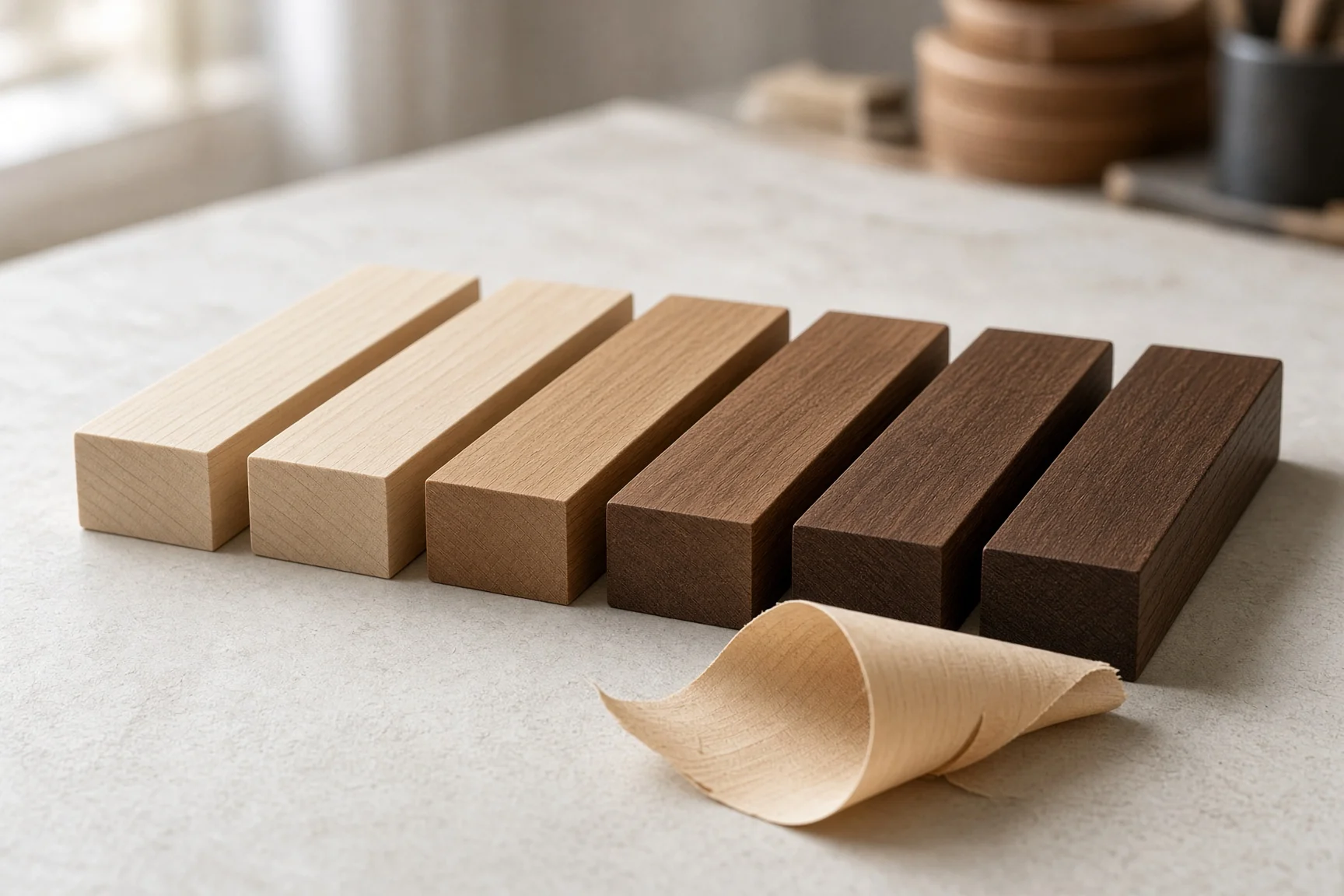
Six pieces of wood lie on a table, ranging from pale to dark brown. Which would you choose for furniture in a new home? Participants in a Czech study faced that question without knowing the species or how the samples had been processed. Every piece was birch. The treated samples had acquired their different shades through heating.
In a study published in 2020, Roman Dudík, Vlastimil Borůvka, Aleš Zeidler, Tomáš Holeček and Marcel Riedl combined measurements of wood properties with a survey of its appeal to potential customers. Their findings show how processing can transform the appearance of a familiar material. Dudík et al., 2020.
How heat changes colour
The laboratory work focused on birch veneer, a thin layer of wood used, for example, to cover furniture surfaces. The researchers tested temperatures of 170, 190 and 200 °C for different durations. Higher temperatures and longer treatments shifted the samples towards darker, warmer brown shades. The authors relate the change to chemical reactions within the wood, particularly the degradation of some components and the formation of oxidation products.
Instrumental measurements captured the transformation. Untreated birch veneer had a mean lightness value, L*, of approximately 83. After three hours at 200 °C, the corresponding value was approximately 51. A lower value means a darker surface. A single species had produced a strikingly varied palette. Dudík et al., 2020, Table 3.
Different shades for different tastes
The survey of the wood's appeal involved 102 participants, who examined physical samples of both solid wood and veneer and rated each one on a five-point scale. Solid birch treated for three hours at 180 °C and the version treated for the same duration at 190 °C each received one of the two highest ratings from approximately 62% of participants. The darkest solid-wood sample divided opinion: around 46% gave it one of the two highest ratings, while 41% chose one of the two lowest. Dudík et al., 2020, Section 3.2.2 and Figure 16.
Those contrasting responses offer a useful direction for furniture design: explore a range of shades. The particular treatment matters, as does the taste of the person choosing the furniture. The veneer samples used in the survey were sanded and finished with colourless wax. A follow-up paper published in 2021 examined the same responses in more detail by age, gender and education. Dudík et al., 2021.
Familiar pale birch can acquire a surprisingly dark shade through heat treatment. The next time you see a dark brown veneer, its species label may be worth a closer look.
References
Dudík, R., Borůvka, V., Zeidler, A., Holeček, T., & Riedl, M. (2020). Influence of site conditions and quality of birch wood on its properties and utilization after heat treatment. Part II—Surface properties and marketing evaluation of the effect of the treatment on final usage of such wood. Forests, 11(5), Article 556. https://doi.org/10.3390/f11050556
Dudík, R., Borůvka, V., Riedl, M., & Holeček, T. (2021). Data mining and its impact on marketing communication – Case: Heat-treated birch wood. Wood Research, 66(3), 463–476. https://doi.org/10.37763/wr.1336-4561/66.3.463476
Sources for this story
Wood Research
Data mining and its impact on marketing communication – Case: Heat-treated birch wood
Dudík, R., Borůvka, V., Riedl, M., & Holeček, T. (2021). Data mining and its impact on marketing communication – Case: Heat-treated birch wood. Wood Research, 66(3), 463–476. https://doi.org/10.37763/wr.1336-4561/66.3.463476
DOI 10.37763/wr.1336-4561/66.3.463476Forests
Influence of site conditions and quality of birch wood on its properties and utilization after heat treatment. Part II—Surface properties and marketing evaluation of the effect of the treatment on final usage of such wood
Dudík, R., Borůvka, V., Zeidler, A., Holeček, T., & Riedl, M. (2020). Influence of site conditions and quality of birch wood on its properties and utilization after heat treatment. Part II—Surface properties and marketing evaluation of the effect of the treatment on final usage of such wood. Forests, 11(5), 556. https://doi.org/10.3390/f11050556
DOI 10.3390/f11050556